What does "digital thread" mean? A manufacturing AI guide
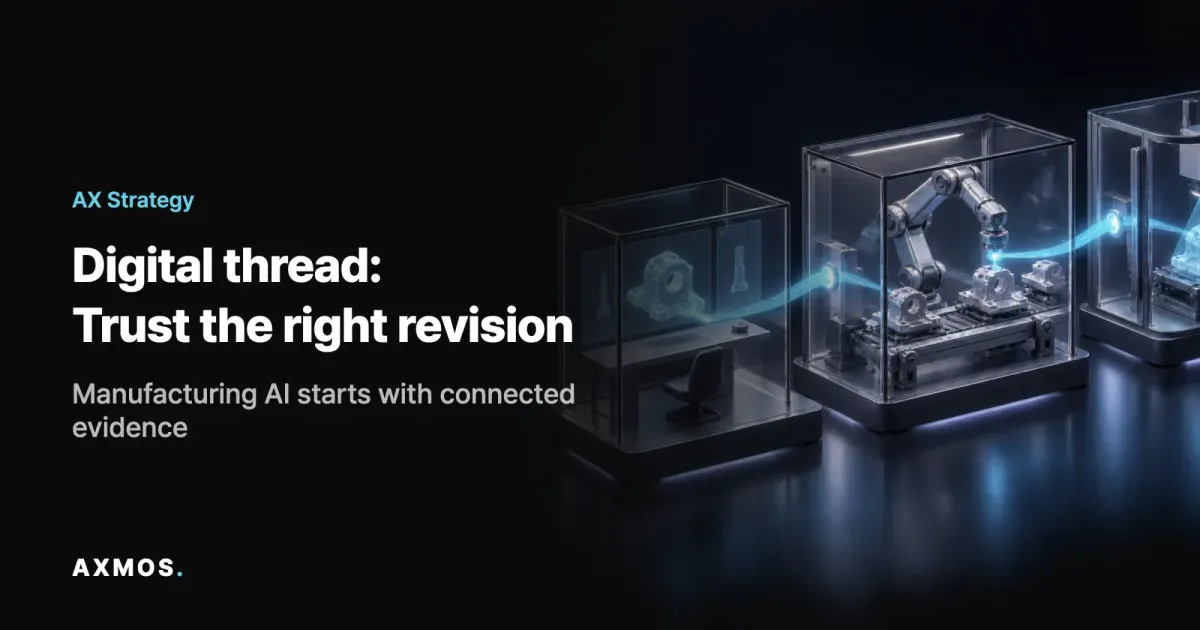
A digital thread connects product evidence across design, manufacturing, and quality. Start with revision traceability before asking AI to act.
Edited by AXMOS Editorial Team | Last updated 2026-10-07
Key takeaways
- A digital thread connects product information across design, manufacturing, and quality; it is not simply a folder of searchable documents.
- NIST identifies authentication, authorization, and traceability as needs for trustworthy product data.
- For a manufacturing AI pilot, AXMOS recommends starting with a bounded revision-checking workflow rather than automatic production changes.
- Evaluate whether the system finds the applicable evidence, not just whether its answer sounds plausible.
What does "digital thread" mean?
A digital thread connects product information across its lifecycle. For a manufacturer, its value is the ability to follow the relationship between a design decision, the records used to build the product, and the evidence used to inspect it.
This is more specific than putting engineering files in a common search interface. In its Digital Thread for Manufacturing project, NIST describes communication from product design to manufacturing and quality activities, and communication back to design engineers. The page adds that this level of integration requires formalizing relationships between data created in different engineering applications.
Consider a hypothetical operations review: an order appears ready, but the bill of materials, or BOM, references a different part revision from the engineering release. An AI assistant might find both documents. The useful task is not to summarize them separately. It is to expose the disagreement, identify the applicable release, and show which records support that conclusion.
This example is an editorial illustration, not an AXMOS customer case. It frames a practical starting point for US manufacturing leaders: before asking AI to move work forward, decide what evidence makes the proposed action valid. A fast answer about the wrong revision is not a completed operational task.
NIST's program page also explains that checking a file's syntax and structure is not enough; its semantic information needs conformance checking. That distinction matters in an AI project. Successfully reading a part number from a spreadsheet does not establish that the number refers to the intended component in the intended configuration.
What are the key differences between a digital twin and a digital thread?
A digital twin models an asset or system and its behavior; a digital thread connects information across the product lifecycle. They can complement each other, but a manufacturer should not treat them as interchangeable project descriptions.
IBM's explanation of the concepts describes a twin as a digital replica using design and operational data, and a thread as a connected representation of lifecycle information. This is a vendor's conceptual explanation, not independent evidence of a financial return. No product purchase is implied by using those definitions.
For a BOM reconciliation project, the immediate question is usually about relationships: which product configuration, which released revision, and which affected work? If the question instead concerns how equipment will behave under changed conditions, an asset model or simulation may be relevant. Define the decision first and choose the technical approach afterward.
| Approach | Question it addresses | What to ask for in a pilot |
|---|---|---|
| Document search | Where is the relevant information? | Retrievable records with access controls and visible source references |
| Digital thread | How are these lifecycle records related? | Traceable links between the applicable design, manufacturing, and quality records |
| Digital twin | How does this modeled asset or system behave? | A defined model, relevant observations, and an agreed validation method |
The pilot requests in this table are AXMOS's proposed evaluation criteria, not a formal certification checklist. They help prevent a scope mismatch: a polished simulation cannot substitute for identifying the correct engineering release, just as a connected file index cannot by itself validate a machine behavior model.
What should a digital thread preserve before AI uses a BOM?
Preserve identity, revision, applicability, and provenance before relying on an AI-generated comparison. Treat missing relationships as unresolved work rather than asking the model to infer them silently.
NIST's digital-thread project calls for trustworthy product data with authorization, authentication, and traceability through the lifecycle. It also describes how intentional or unintentional data tampering can propagate through connected systems. These are research priorities and technical concerns, not proof that a particular manufacturer's data is defective.
For an initial BOM workflow, use those concerns to define a local evidence contract. Each result should identify its source record, the revision or release state used, the product or work to which it applies, and the person or system responsible for that record. If a source changes after extraction, the result should no longer be treated as automatically current.
Do not collapse different relationships into a generic match. A supplier's alternative part, a company's internal part identifier, and a released assembly requirement may describe related things without being interchangeable. In the proposed workflow, the assistant should label the relationship it found and show the underlying evidence. An authorized owner should resolve ambiguity.
Likewise, define what each quantity means before reconciling it. A quantity in a design structure and a quantity assigned to a work order answer different business questions. Use explicit field definitions and units in the integration design. Where the systems disagree, preserve the disagreement in an exception record instead of producing an apparently clean combined value.
These are recommended operating controls. They do not constitute a claim that a language model can independently establish engineering suitability or compliance. The starting objective is a reviewable evidence package, with responsibility for release decisions left in the existing authorized process.
How can a manufacturer test a digital thread without a plant-wide overhaul?
Start with a read-only evidence workflow for a bounded product family and a defined operational decision. Demonstrate that the relationships survive real exceptions before expanding the scope or adding write access.
NIST's AI for Manufacturing research initiative, updated in July 2026, focuses on measurement science, human-AI teaming, and interoperability. Its research plan includes evaluating integration effort, performance, semantic correctness, and scalability. These are planned evaluation activities, not completed results or benchmarks that any vendor has already passed.
The following sequence is AXMOS's proposed application of those priorities to an operations pilot:
- Select the decision. Define a narrow task such as preparing a revision-discrepancy packet for engineering review. State what the assistant may read and explicitly exclude ordering, release, and machine-control actions.
- Name the authoritative records. Ask engineering, planning, and quality owners to identify the source for each required field. Record the conditions under which an exported spreadsheet is valid and when a fresh extract is required.
- Specify the output contract. Require a discrepancy description, linked evidence, affected record identifiers, and unresolved questions. A response without the necessary evidence should be marked incomplete rather than accepted because it is fluent.
- Build a representative test set. Include ordinary cases and deliberately selected exceptions: missing releases, ambiguous identifiers, conflicting units, and unavailable records. Label these as test scenarios, not claims about the plant's actual error frequency.
- Review with the decision owner. Compare the proposed packet with the existing process. Track what the reviewer accepted, corrected, or rejected and why; distinguish source problems from extraction and reasoning errors.
- Expand only after agreed acceptance criteria are met. Write down the conditions for widening access, adding product families, or proposing transactions. Keep a clear way to return to the established manual process when the evidence is incomplete.
Measure review effort as well as preparation effort. If the assistant produces a packet quickly but the engineer must reconstruct every source relationship, the task has not become meaningfully easier. Record total handling time and correction work for comparable cases; do not convert a demonstration into a promised annual savings figure.
Pay particular attention to abstention. A system that reliably flags an unknown revision may be more useful for this workflow than one that always returns a confident recommendation. Decide in advance which missing fields force escalation and make that behavior visible in the acceptance test.
The deliverable should be more than a working connector. Keep a record of field meanings, ownership, permissions, exception routing, and the tests used to approve the workflow. That documentation gives the operations team a basis for checking the integration when source systems or product rules change.
FAQ
Q. What does "digital thread" mean?
A digital thread connects product information across lifecycle stages so teams can trace relationships between design, manufacturing, and quality records. For an AI workflow, the practical test is whether an answer points to the applicable source and revision.
Q. What are the key differences between a digital twin and a digital thread?
A digital twin models an asset or system and its behavior, while a digital thread connects information across its lifecycle. A manufacturer can start linking controlled product records without first building a simulation of the plant.
Q. Does a digital thread require replacing every spreadsheet?
Not as a starting condition in the approach proposed here. A controlled spreadsheet can remain an input if its owner, revision, intended use, and relationship to authoritative records are explicit.
Q. Should AI approve a BOM change?
In the starter workflow proposed here, AI should prepare an evidence-backed comparison, not approve the change. Engineering or the designated release authority should decide whether the proposed change applies to the affected product and work.
Q. How should a manufacturer measure the first pilot?
Measure accepted outputs, review effort, unresolved discrepancies, and whether each answer identifies the correct source and revision. Compare similar cases with the existing process and count correction work rather than treating generated answers as completed work.
Where does AXMOS recommend starting?
AXMOS sees the first useful digital-thread investment as a connected decision workflow, not a plant-wide promise. Choose an operational handoff where people must reconcile product records, preserve the evidence required to review it, and measure whether the work is actually completed with less rework.
That view is consistent with AXMOS's public focus on connecting fragmented systems and redesigning manual workflows. Its public site also describes field-based delivery through an FDE; the AXMOS team and alliance overview provides organizational context. Neither statement implies US customer deployments or a guaranteed manufacturing outcome.
Bring the process owner, the source records, and the acceptance conditions to the same discussion. Establish what must remain a human decision before adding automation. Get in touch with AXMOS to discuss the workflow you want to examine.
Sources
- NIST: Digital Thread for Manufacturing. Project page, updated August 12, 2026. Product-data relationships, semantic conformance, and trustworthy-data requirements.
- NIST: Artificial Intelligence (AI) for Manufacturing. Project page, updated July 17, 2026. Research plans for human-AI teaming and integration evaluation, not reported performance outcomes.
- IBM: Digital Twin vs. Digital Thread. Vendor-authored conceptual explanation; not used as ROI evidence.
- AXMOS official English website. Public workflow and delivery positioning, reviewed October 7, 2026.